Showing posts with label chapter book. Show all posts
Saturday, June 22, 2013
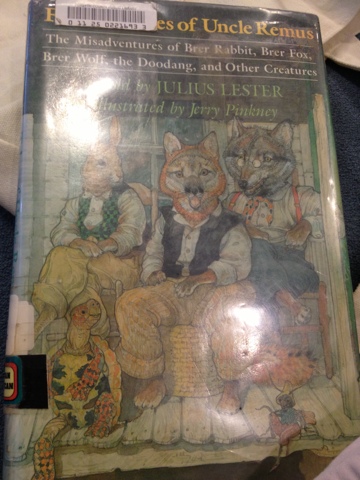
Further Tales of Uncle Remus - Author Study
Lester, J. (1990). Further Tales of Uncle Remus. Dial Books: New York.
Although four Uncle Remus Books were published, they were later republished as a complete collection so this third book was the last one that I could personally get a copy of. This book continues to have encounters between Brer Rabbit and Mr. Man but also other animals mishaps with Mr. Man as well. This collections introduces new characters such as Brer Buzzard and Brer Polecat. What is important to note in these books that I hadn't noted before was that when Lester originally read Joel Chandler Harris's versions of these stories they were in "black slave language" and thus they were hard for those that speak common English today to understand. Lester kept some of that slang or dialect as we refer to it, like Ain't and gon' but made it so the entire story isn't filled with that language.
The reason I point out language is because it is important to teach students about the use of dialect and slang in writing and when it is appropriate and when it is not. The lesson is great to discuss author's purpose and language choice. This collection is a good example of that. The introductions written by Lester helped to give students the background knowledge to better synthesize the stories and make inferences from them.
Friday, June 21, 2013
More Tales of Uncle Remus - Author Study
Lester, Julius (1988). More Tales of Uncle Remus. Dial Books: New York.
When Julius Lester wrote his first Uncle Remus book he was rewriting a collection from Joel Chandler Harris. This collection had 263 tales and 113 with Brer Rabbit. Thus, it was not surprising that after receiving the Coretta Scott King Award for his first Uncle Remus book, he wrote another. IN the introduction, by Julius Lester, he explains that Brer Rabbit is not a personified slave or even a black man but a personification of all people - black or white. These are considered by Lester as "Trickster tales" and thus this collection and are not to be interpreted as moral lessons. Lester does say though that Brer Rabbit was created by slaves and thus the importance in Afro-American history. This collection has Brer Rabbit teaming up with Brer Fox, falling in love, and the introduction to Mr. Man.
This is a great continuation of the Uncle Remus stories as presented yesterday and could be taught in a similar way, but using different characters or talking about how those characters interact and what impact they have on Brer Rabbit's life.
When Julius Lester wrote his first Uncle Remus book he was rewriting a collection from Joel Chandler Harris. This collection had 263 tales and 113 with Brer Rabbit. Thus, it was not surprising that after receiving the Coretta Scott King Award for his first Uncle Remus book, he wrote another. IN the introduction, by Julius Lester, he explains that Brer Rabbit is not a personified slave or even a black man but a personification of all people - black or white. These are considered by Lester as "Trickster tales" and thus this collection and are not to be interpreted as moral lessons. Lester does say though that Brer Rabbit was created by slaves and thus the importance in Afro-American history. This collection has Brer Rabbit teaming up with Brer Fox, falling in love, and the introduction to Mr. Man.
This is a great continuation of the Uncle Remus stories as presented yesterday and could be taught in a similar way, but using different characters or talking about how those characters interact and what impact they have on Brer Rabbit's life.
Thursday, June 20, 2013
The Tales of Uncle Remus - Author Study
Lester, J. (1987) The Tales of Uncle Remus. Dial Books: New York.
This book is a collection of stories told by Uncle Remus. The forward of the book explains that when the stories were first published by Joel Chandler Harris in the late 1800s. In those books Uncle Remus was an obedient slave who told these stories as a form of entertainment to the white slave owner's child. The cultural thought those is that Brer Rabbit was in fact a personification of a slave and Brer Fox whom he often tricks is a slave owner. In this collection, Lester write Uncle Remus, the storyteller, to be neither a slave nor a black person but a voice who is retelling the stories. It is felt that they are an important part of black culture and history.
This book would work well when chosen stories are pre-selected for either reading groups or independent reading that would lend themselves well to reading responses. Because many of the stories have a central character but do not need to be read in order students can teach each other about the story that they read and then they can come up with a character profile of Brer Rabbit from the retold stories.
This book is a collection of stories told by Uncle Remus. The forward of the book explains that when the stories were first published by Joel Chandler Harris in the late 1800s. In those books Uncle Remus was an obedient slave who told these stories as a form of entertainment to the white slave owner's child. The cultural thought those is that Brer Rabbit was in fact a personification of a slave and Brer Fox whom he often tricks is a slave owner. In this collection, Lester write Uncle Remus, the storyteller, to be neither a slave nor a black person but a voice who is retelling the stories. It is felt that they are an important part of black culture and history.
This book would work well when chosen stories are pre-selected for either reading groups or independent reading that would lend themselves well to reading responses. Because many of the stories have a central character but do not need to be read in order students can teach each other about the story that they read and then they can come up with a character profile of Brer Rabbit from the retold stories.
Wednesday, June 19, 2013
Day of Tears - Author Study
Lester, J. (2005) Day of Tears. Hyperion Books: New York.
This is the story of a slave named Emma who has helped to raise her master's daughters since their mother left. Her master is a very wealthy landowner with many slaves but he gets himself into a lot of problems due to a gambling debt. This story is about the two days that he needed to auction off his slaves in order to pay off his $300,00 gambling debt. This was an actual event and is called the day of tears because it rained hard throughout the entire auction and stopped almost immediately as soon as the auction was complete.
If you've read enough of this blog, you know that I always look for books that are written from a unique point of view. This book is true to that choice and passion. It is written as a novel in dialogue. I cannot think of any other novel that is written in this way. I've read novels in poetry but never in dialogue. This book would be great for students to practice their fluency and to read in a reading group because students can take roles and see the author's true intent and reasons for writing in dialogue.
Saturday, June 8, 2013
Something Upstairs - Contemporary Fiction Chapter book
Avi (1988). Something Upstairs. Avon Books: New York.
This story centers around a boy named Kenny who recently moved from Los Angeles to Rhode Island. In his new home appears to be a ghost and a mysterious stain on the floor of the room the ghost is trying to escape from. As Kenny talks to and gets to know they ghost he learns that the ghost was once a slave, named Caleb, in that house and is trying to get free. Kenny is the only one who can get him free by discovering who killed the slave in the first place and therein lies the mystery!
Contemporary Fiction - mystery (although you could make a case that this is a fantasy novel because there is time travel). Grades 3-6
The main character is trying to investigate and solve the murder of a slave from the early 1800s. If the boy does not find the slaves murderer than the slave will have ghost. Despite the boy's fear, he travels back to the 1800s to learn about slavery in Rhode Island and how the slave trade was big business for a few slave traders and they did not want slavery to abolished and would go to extreme ends to ensure that slavery remained.
This is a great book for students to practice the Mosaic of thought with and independently show their use of the comprehension strategies. There are multiple opportunities for inferences, determining what is important, using prior knowledge of slavery, asking questions, creating mental images and monitoring for comprehension. In fact, this book is a wonderful way for a child to practice all of the strategies.
The Adventures of High John the Conqueror - Traditional Literature Chapter book
Sanfield, S. (1989). The Adventures of High John the Conqueror. Orchard Books: New York.
This book is a series of short storied that are all folk tales about a slave named High John. As with all folk tales, these have been passed down through generations and through slave populations about High John who was always a little more clever than his masters. His cleverness gets him free as he often makes bets with his master and outsmarts him. The tales continue into ways that High John was able to outsmart people as a free man as well. A particularly famous tale that is included in this collection is "Tops and Bottoms". It is how High John made a deal with a farm owner to share their crops and John always got the best of him. There are also history lessons about slavery and slave times included where it helps one to enhance the story or make meaning of the language or events.
Traditional literature Chapter book - Folk tale. Grades 2-4. All artwork contained is pencil drawings.
There are quite a bit of folk tales from slave times because slaves were not taught to read or write so they often told one another stories. The stories about outwitting a slave owner or ways in which slaves got ahead were always interesting and passed down to many. What makes these stories of slavery great is that they weren't just about a slave and his owner but they were also about slaves relationships with one another.
This book is great for guided reading in that the stories are short (only a few pages) and all groups can read one or two. They can also read the historical information that goes along with the story. It helps to build their schema. There can be extensions done with these stories and students would love to act them out.
Ship Breaker - Fantasy chapter book
Bacigalup, P. (2011) Ship Breaker. Little Brown Group: New York.
Ship Breaker is about a boy named Nailer in a future world here in the United States. Nailer is in a slaves state as a ship breaker (someone who scavenges old ships for parts). He lives day to day and receives very little in terms of food for survival. He can only trust his "crew" and then is betrayed by one of his own and his outlook on life changes. He finds his ticket to freedom and wealth and doesn't take it but believes in trust instead. He follows the "Lucky Girl' (Nita) in hopes that she can find her family and that will one day take him to a better place. His journey with her leads her to see New Orleans and the life of the have and have-nots in this new dystopian society that is now the southern United States.
Fantasy chapter book (dystopian future). Grades 7-12.
I find it ironic that the last book I read for the theme set is is the only one that doesn't focus on US history and African American slavery but yet it still takes place in that same location. Although this book doesn't have slavery as we recall it from our history, Nailer, the main character in this book is living in a slave society of those that have things and those that don't. They rely on family and those that they trust and they are always dreaming of freedom while working hard and few ever attain it.
This book is a great one to read in parallel to a study of US slavery in the 1800s because a reader response can be for children to compare the characters to that of slaves from history. How does this story parallel slaves of the past. Students can draw the comparisons as they study the past of what the future can hold. They then can analyze using facts from Ship Breaker what were the causes for society to become this way and create a plan for how to avoid such a future for out country. It is a great cross curricular study of history!
Thursday, June 6, 2013
Carver: A life in Poems - Poetry Chapter Book
Nelson, M. 2001) Carver: A life in Poems. Library of Congress Cataloging: New York.
This is a a biography written in a series of poems from the point of view of people that had experiences with George W. Carvery throughout his life. If helps to chronicle a bit of American history as it travels through slavery, segregation, the depression and WWI. Carver was born from a slave mother but was raised by his white owners as their own when his mother was kidnapped. It is those "adoptive" parents who set him free to pursue his education and his passions in life. He eventually got his master's degree and was a professor in agriculture. The amount of research he did into the uses of peanut is incredible - my kind of man! I love peanuts.
Poetry chapter book (but also a biography). Grades 6+.
This book is significant in the study of slavery because it gives hope to slaves that there is a future. Carver suffered a lot and was faced with many barriers and hatred. He crossed racial barriers and was in love with a white woman who committed suicide. He was also discriminated by his colleagues and fellow African Americans because he spoke "like a white person" and had an advanced degree and wore "white people clothes."
This book would lend itself to reading talk. There is a lot that needs to be inferred and connected from one poem to the next in this book and it would help students to be able to put the pieces of Carver's life together if the students could talk about it. Poetry also is a great resource for reader response. There is meaning that can get made from each of these poems although the meaning has a purpose from the author, the reader does not need to create that purpose.
Tuesday, June 4, 2013
Juneteenth: A Day to Celebrate Freedom - Informational Text Chapter book
Leeper, A. (2004 ). Juneteenth: a day to celebrate freedom from slavery. Berkeley Heights, NJ: Enslow Publishers, Inc.
This book describes the origins, the celebration and the growth of an African American holiday - Juneteenth. Juneteenth is a holiday to celebrate the last day that slaves found out they were free in Texas. The holiday is celebrated with parades, barbecues and red soda pop (it never explained the significance of red soda pop other than it was part of the first Juneteenth celebration. It may have been a luxury item in the time of slavery and something slaves couldn't normally drink, but once free they could. Red soda pop was referred to multiple times as part of the celebration).
Informational Text - chapter book for grade 2-5. It contains mostly photographs and maps to support the text.
When telling a friend about my project on reading a book a day, she told me to go to the Juneteenth celebration here in Winston-Salem. Growing up in Connecticut I had never heard of such a celebration and thus felt that if I was going to read an informational text about slavery, I might as well read about information I don't already know about, thus my choice of text. Juneteenth was the day that the slaves in Texas (some of the last slaves still in America) found out about the Emancipation Proclamation that all slaves were free and thus this is a day that African Americans in Texas and other states celebrate their freedom.
This is a great book to use Louise Rosenblatt's transactional theory concept with. There will certainly be students whose families are very involved within the African American community who have heard of and experienced this holiday. There will be others who have never heard of it. It is a great way to just present the word and have people write what it means, what they know about it, etc. I only wish it fell while we were in school to share the celebration with the class.
Who Was Harriet Tubman? - Biography Chapter Book
McDonough, Y. Z. (2002). Who was Harriet Tubman? New York, NY: Penguin Putnam Books for Young Readers.
This book is part of the "Who Was..." series of biographies. They are all written so that they are more accessible for younger students to read biographies. This book give a full listing of events in her life. It talks about her young childhood and how she learned many of the survival skills that helped her be a conductor on the Underground Railroad. What it also went into detail about was that her life's work was more than just the Underground Railroad. She was only doing the Underground Railroad for 8 years. She usually ran slaves twice a year but had such a steep price on her head that she had to stop. She did so much more with her life. She was a military nurse, a spy for the northern army, started a Home for those that needed help or caring for, spoke at many rallies and so much more. Harriet Tubman is known for what she did on the Underground Railroad, but her life was filled so much more!
Biography for Grades 2-5. It is a chapter book with black and white pencil sketches, diagrams, and maps to aid in understanding
Harriet Tubman is a significant person to any study of the Underground railroad. I had never read any books as part of this series and I wanted to as to determine their usefulness in nonfiction literature.
This book is a great book to help dissuade those students who have a negative feeling towards academic reading. There is a great amount of knowledge that can be gained from this book and it can be read by many academic levels and still attain information. I only wish it contained more nonfiction text features, like and index, a glossary, or bold words so that it could be even more accessible as an academic text.
Monday, June 3, 2013
Trouble Don't Last - Historical Fiction - Chapter
Pearsall, S. (2002). Trouble Don't Last. New York: Random House.
Samuel is an 11 year old boy born into slavery where Mz Catherine and Mas'r Hackler do not make his life easy, neither do their two sons. Until one day when fellow slave Harrison,much older than him, wakes him up and forces him to run for freedom. The book carries their journey navigating the Underground Railroad, full of distrust and both whites and blacks that Harrison teaches Samuel to be cautious of. Throughout their journey, Samuel learns of Harrison's secrets and Samuel's past, including his mother and grandfather's identities.
Historical Fiction Chapter book - Historical Era - Slavery and the Underground Railroad of 1859
Grades 6-8
Seeing that my theme is slavery and Trouble Don't Last won the Scott O'Dell Award for Historical Fiction book, it seemed only fitting that it be the first book that I place into my study of slavery. There will be many stories from the slaves point of view while I cover this topic. I personally love books from a unique perspective and when reading to children, I love books from a child's perspective. I was also reading this book alongside my eleven year old niece. I believe that as readers we love to talk about our reading, so whenever I can, I like to talk about my reading with someone. It just happened that she was reading this book as well.
Because of the language and the dialect used in this book, this book lends itself well to guided reading. There is a lot that a teacher can help to guide the students into understanding. There is a lot of discussion around character's feeling and motivations - like why Samuel continually wants to go back to his master? Why does he not want to find freedom? These are questions that having a teacher pose to students allows them to think about and delve into.
Subscribe to:
Posts (Atom)


